
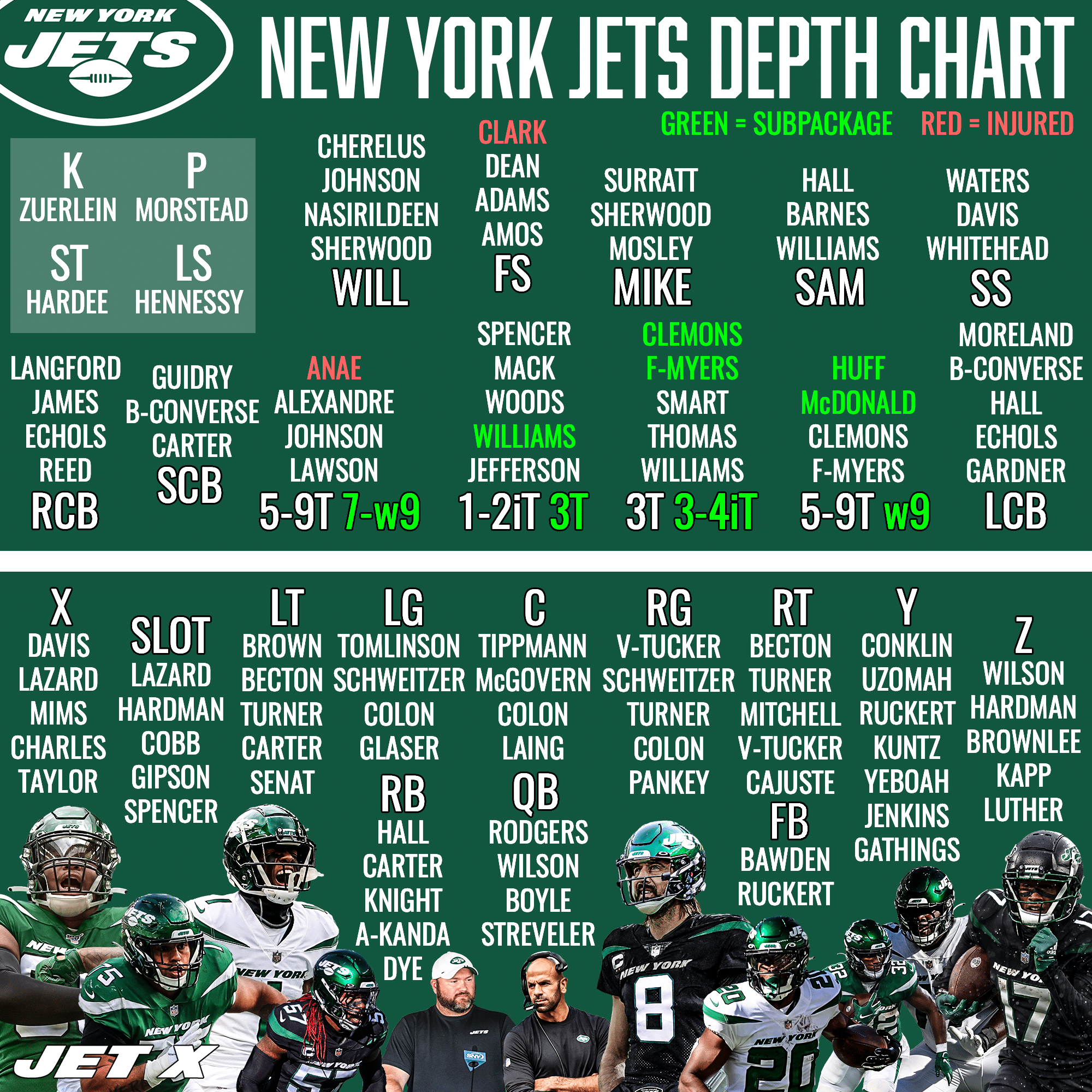
The New York Jets’ unofficial depth chart for 2024 is out, offering fans and analysts a first glimpse at the team’s evolving roster and strategic direction. This year’s chart reveals key positional battles and new player integrations, signaling a season of potential and high expectations. With a focus on revamped formations, here are six must-see takeaways from the Jets’ initial lineup, directly from the team’s official website, providing a roadmap for the upcoming season.
Table of Contents
Offensive Line Overhaul
The most significant takeaway from the depth chart is the extensive makeover of the Jets’ offensive line. According to the Jets’ official announcement, three new starters are set to anchor the line, aiming to provide consistent protection for quarterback Aaron Rodgers and bolster the running game.
New Starters and Positional Shifts
The revamped offensive line features veteran additions Tyron Smith at left tackle and Morgan Moses at right tackle. These acquisitions are expected to bring stability and experience to the edges of the line. Furthermore, John Simpson is slated to start at left guard, adding a new dimension of physicality to the interior. This also facilitates a permanent shift for Alijah Vera-Tucker to right guard, a move designed to optimize the line’s overall cohesion and aggressiveness.
The Jets are banking on these changes to significantly improve their offensive line performance, which has been a point of concern in recent seasons. The blend of seasoned veterans and versatile players like Vera-Tucker could be the key to unlocking the Jets’ offensive potential.
Defensive Line Dynamics
The defensive line is another area of intrigue, with new faces looking to make an immediate impact alongside established star Quinnen Williams. The depth chart provides insights into how the Jets plan to utilize their new defensive acquisitions.
Kinlaw and Fotu’s Integration
Solomon Thomas is listed behind Quinnen Williams, while Javon Kinlaw and Leki Fotu are positioned next to Williams on the first and second teams, respectively. Kinlaw, in particular, has garnered attention for his offseason transformation and is aiming to build upon his career-high 3.5 sacks from the 2023 season. According to the Jets’ coaching staff, Kinlaw’s dedication and physical conditioning have been impressive, suggesting he could be a valuable asset in disrupting opposing offenses.
The addition of Kinlaw and Fotu aims to provide depth and versatility to the defensive line, allowing the Jets to rotate players effectively and maintain pressure on opposing quarterbacks throughout the game. Their presence could also free up Williams to be even more disruptive, creating a formidable defensive front.
Edge Rusher Opportunities
The absence of Haason Reddick from training camp has opened up an opportunity for other edge rushers to step up and showcase their abilities. The depth chart highlights one player in particular who is poised to capitalize on this situation.
Clemons’ Chance to Shine
With Haason Reddick not yet participating in camp, Michael Clemons is currently listed as a starting edge rusher opposite Jermaine Johnson. This presents a significant opportunity for Clemons to prove his worth and potentially secure a more prominent role in the defense. Will McDonald, a 2023 first-round pick, is currently with the second team behind Johnson, indicating that he still has work to do to climb the depth chart.
Clemons’ performance during training camp and the preseason will be closely watched, as he looks to demonstrate his ability to consistently pressure the quarterback and contribute to the Jets’ pass rush. The coaching staff will be evaluating his technique, effort, and overall impact on the field.
Safety Position Outlook
The safety position is another area where the depth chart provides clarity on the current pecking order and potential roles for various players. One player, in particular, is looking to solidify his place in the secondary.
Davis’s Role and Rookie Competition
Ashtyn Davis, who saw action in big nickel packages last season, is listed behind Chuck Clark at one safety position. Following Davis are rookies Jaylen Key and Al Blades Jr., who will be competing for roster spots and opportunities to contribute on special teams and in defensive packages. According to team reports, the rookies have shown promise in early practices, but they still need to prove their consistency and ability to handle the complexities of the Jets’ defensive scheme.
Davis’s experience and familiarity with the system give him an edge, but the rookies will be pushing him for playing time. The safety position battle will be one to watch throughout training camp and the preseason.
Wide Receiver Landscape
The wide receiver depth chart is affected by Mike Williams’ placement on the Physically Unable to Perform (PUP) list, creating opportunities for other receivers to step up and make their case for playing time. The team’s strategy reflects a “next man up” mentality.
Lazard’s Opportunity and Gipson’s Role
With Mike Williams sidelined, Allen Lazard is currently listed at the top of the depth chart across from Garrett Wilson. Lazard is looking for a bounce-back season after a disappointing 2023 campaign, where he caught just 23 passes in 14 games. Xavier Gipson is penciled in as the starting slot receiver, despite nursing a leg injury. According to offensive coordinator Nathaniel Hackett, Lazard has been working hard to improve his route running and chemistry with Aaron Rodgers, and the team is optimistic that he can be a reliable target in the passing game.
Gipson’s ability to recover from his leg injury and perform consistently in the slot will be crucial for the Jets’ offense. The team needs a reliable slot receiver to complement Wilson and Lazard and provide Rodgers with a variety of options.
Center Competition and Depth
The center position features an ongoing competition, with multiple players vying for the starting role. The depth chart provides insight into the current state of this position battle and the team’s overall depth along the offensive line.
Tippmann vs. Myers
Joe Tippmann is currently listed with the first team at center, but he faces stiff competition from Josh Myers. Max Mitchell and Wes Schweitzer have also been getting reps with Aaron Rodgers on the right side of the line, with Mitchell as a second-team right tackle and Schweitzer as the right guard behind Alijah Vera-Tucker. According to offensive line coach Keith Carter, the competition at center is expected to continue throughout training camp, and the team will ultimately choose the player who demonstrates the best combination of technique, communication, and consistency.
The depth along the offensive line is a positive sign for the Jets, as it provides them with options in case of injuries or performance issues. The competition at center will be closely watched, as the team looks to solidify its offensive line and provide Rodgers with the protection he needs to succeed.
Conclusion
The Jets’ unofficial depth chart for 2024 offers a valuable glimpse into the team’s current thinking and strategic direction. The revamped offensive line, the integration of new defensive players, and the positional battles at key spots all point to a season of high expectations and intense competition. As training camp progresses and the preseason unfolds, these initial takeaways will evolve, providing a clearer picture of the Jets’ final roster and their chances of making a deep playoff run.
